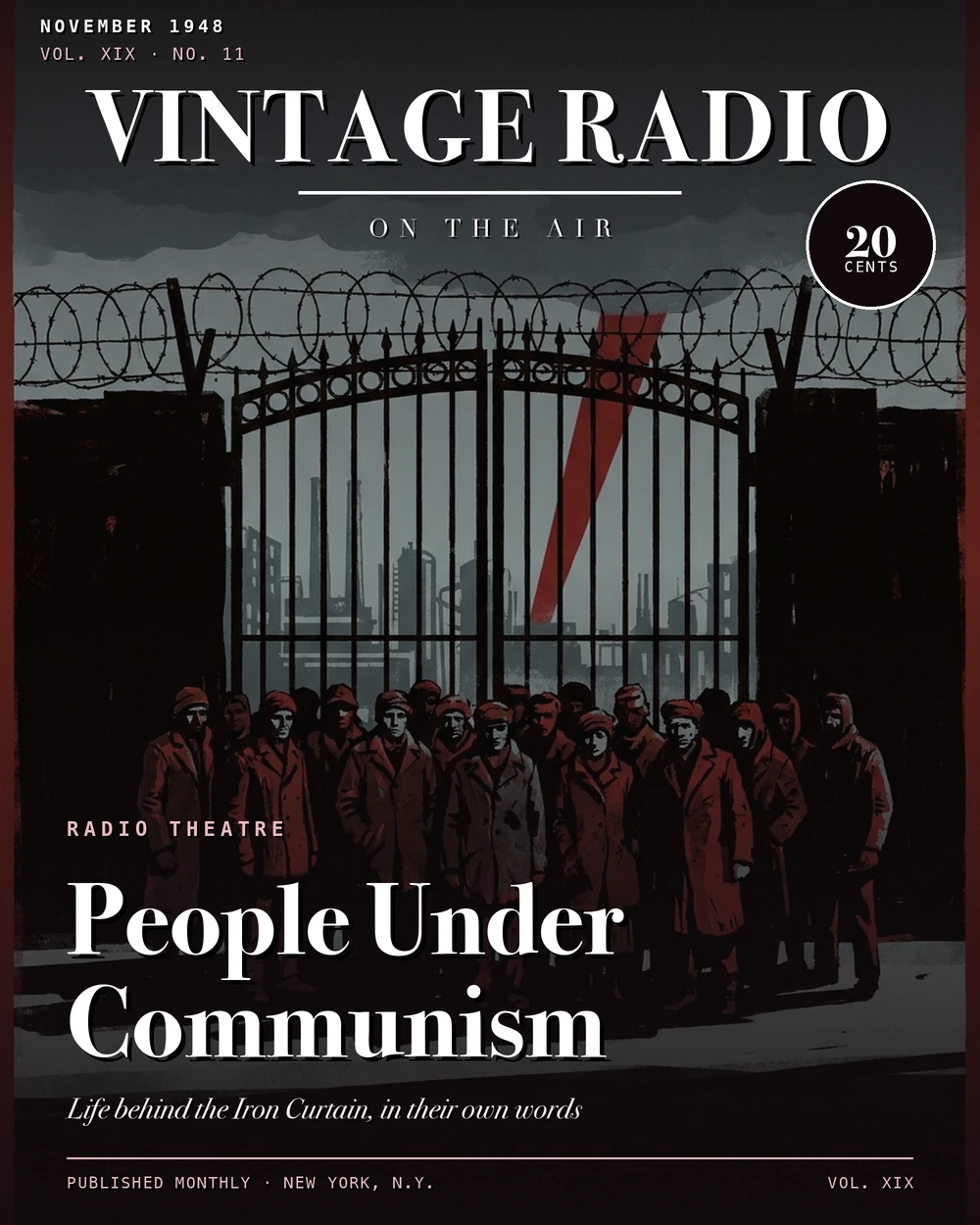
People Under Communism
What the Series Set Out to Do
People Under Communism is a History series built around a straightforward but serious purpose: to put a human face on life under communist governance. Rather than arguing ideology in the abstract, the program works through personal stories and historical accounts, showing how ordinary families navigated censorship, economic hardship, and the steady pressure of political indoctrination. The narratives range from the mundane to the extreme — both the grinding daily compromises and the moments of outright despair or quiet resilience. What ties the episodes together is an interest in the voices that communist regimes worked hardest to suppress.
The four surviving episodes suggest a series that moved across different pressure points of communist rule. "Terror as a System of Power" addresses institutionalized state violence. "Drama to Order" and "Music of the Order" both look at what happened to artists and performers when the state took control of cultural life — theater and music pressed into the service of political conformity. "The Men Who Made the Migs" shifts the lens toward Soviet military-industrial ambition, examining the human story behind the aircraft that became one of the defining symbols of Cold War aerial conflict. Together, the four episodes sketch a picture of how totalitarian systems shaped not just political life but personal and collective identity.
The Cold War Radio Context
The series fits squarely within a cluster of American radio documentary and docudrama programming that emerged in the late 1940s and ran through the 1950s. U.S. networks during this period were actively using broadcasting to educate domestic audiences about life behind the Iron Curtain, and People Under Communism belongs to that current. The episode referencing MiG fighter aircraft — developed in the late 1940s and widely deployed during the Korean War — suggests the series most likely aired in the early to mid-1950s, when Soviet air power was a frequent subject of American public concern.
A useful point of comparison is You Are There, the CBS Radio historical docudrama created by Goodman Ace that ran from 1947 to 1950 (originally titled CBS Is There), which dramatized historical events with reporters interviewing participants as if broadcasting live. People Under Communism appears to work in a similar docudrama register, blending historical fact with dramatized personal narrative. Another contemporary series, I Was a Communist for the FBI, which aired in 1952, took a more explicitly dramatic and patriotic approach — a vehicle to warn against the evils of communism at the height of Cold War tensions. People Under Communism seems to have aimed at something more documentary in character, centered on the lived experience of those inside communist societies rather than on espionage or ideological confrontation.
What Survives and What Isn't Known
Honest accounting: People Under Communism is a sparsely documented series. No network affiliation, no confirmed broadcast dates, no producers, writers, or cast members have surfaced in the available record. Four episodes survive, and the episode titles themselves carry most of what can be inferred about the program's scope and intent. It is not a marquee title from the golden age of radio documentary, and the historical record doesn't treat it as one.
What can be said is that the four episodes cover real and substantial ground — state-controlled art, institutionalized terror, military technology, and the mechanics of propaganda. Whether the series ran for a single short season or was always conceived as a limited documentary set is unknown. What exists is a small, focused body of work on a subject that American broadcasting took seriously during the early Cold War years, preserved well enough that the four episodes can still be heard.